
The UP PRT Syllabus 2026 (UP Primary Teacher Syllabus) and UP Junior Teacher Vacancy 2026 Syllabus have both been released by the Uttar Pradesh Shiksha Sewa Chayan Ayog (UPESSC) for the Assistant Teacher recruitment covering Class 1-5 (Primary/PRT) and Class 6-8 (Junior Teacher/Junior High School Teacher) posts. Both exams run on a 120-question, 120-minute, 3-marks-per-question pattern with 1 mark deducted for every wrong answer.
But the two exams are not identical — the subject weightage, section structure, and optional-subject choices differ sharply between the UP PRT syllabus and the Junior Teacher syllabus, and mixing them up while preparing is a common, costly mistake. This guide breaks down the exact UP PRT exam pattern, subject-wise question distribution, and full topic-wise primary teacher syllabus 2026 — in Hindi and English together — straight from the official UPESSC notification, so there’s no need to hunt through a scanned PDF for the details that actually decide your preparation strategy.
Table of Contents
UP Assistant Teacher Recruitment 2026: Quick Overview
| Detail | UP Primary Teacher (PRT) | UP Junior Teacher |
|---|---|---|
| Conducting Body | UP Shiksha Sewa Chayan Ayog (UPESSC), Prayagraj | UP Shiksha Sewa Chayan Ayog (UPESSC), Prayagraj |
| Post Covers | Class 1 to 5 | Class 6 to 8 |
| Exam Duration | 2 hours (120 minutes) | 2 hours (120 minutes) |
| Total Questions | 120 | 120 |
| Total Marks | 360 (3 marks × 120) | 360 (3 marks × 120) |
| Question Type | MCQ, 4 options each | MCQ, 4 options each |
| Negative Marking | -1 for each wrong answer | -1 for each wrong answer |
| Number of Papers | Single paper, single section | Single paper, 2 sections |
| Optional Subject Choice | None — same syllabus for all candidates | Yes — choose 1 of 3 streams for Section 2 |
| Question Paper Language | English and Hindi | English and Hindi |
| Official Website | upsessc.gov.in | upsessc.gov.in |
REQUIRES OFFICIAL CHECK: total vacancy count, application dates, and eligibility criteria are part of the separate UP Primary Teacher Vacancy 2026 recruitment notification, not this syllabus document — candidates should confirm those details on the official UPESSC website.
UP PRT Syllabus 2026 PDF: How to Download the Official Syllabus
Many candidates search for a “UP PRT syllabus 2026 PDF” or “primary job syllabus 2026 PDF download” — here’s exactly where to get the genuine, official document rather than an unofficial copy:
- Visit the official UPESSC website: upessc.gov.in.
- Go to the Syllabus/Notification section for the Assistant Teacher (Sahayak Adhyapak) recruitment.
- Download the UP PRT syllabus PDF (Class 1-5) or the UP Junior Teacher syllabus PDF (Class 6-8), depending on which post you’re preparing for.
- Cross-check the PDF’s issue date against the notification date to make sure you have the latest version, since UPESSC occasionally issues corrigenda.
Every topic and mark distribution in this guide is transcribed directly from that official UPESSC syllabus PDF — use this article as your quick-reference table, and the official PDF as your source of record.
UP Primary Teacher (PRT) Exam Pattern 2026
The UP Primary Teacher (Class 1-5) recruitment exam 2026 has 120 MCQs for 360 total marks, to be completed in 120 minutes. Every question carries 3 marks, and 1 mark is deducted for each wrong answer.
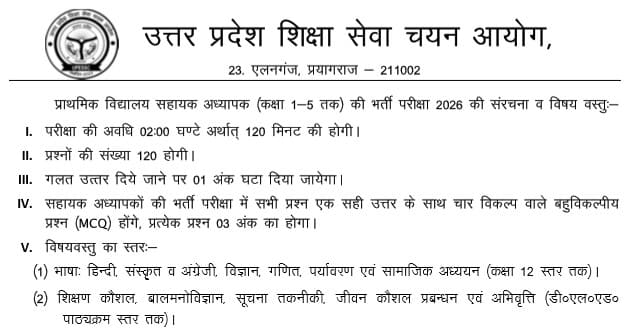
- Duration: 2:00 hours (120 minutes)
- Total questions: 120
- Marks per question: 3
- Total marks: 360
- Negative marking: -1 mark per wrong answer
- Question format: Multiple-choice, 4 options, 1 correct answer
Content difficulty level (as per the official notification):
- Language subjects (Hindi, Sanskrit and English), Science, Mathematics, and Environment & Social Studies are set at up to Class 12 level.
- Teaching Skills, Child Psychology, Information Technology, and Life Skills/Management & Attitude are set at up to D.El.Ed syllabus level.
UP Primary Teacher (PRT) Syllabus 2026: Subject-Wise Topics
The PRT syllabus is spread across 10 subjects. General Knowledge/Current Affairs (25 questions) and Hindi-Sanskrit-English (30 questions) together account for nearly half the paper, so these two areas carry the highest weightage in the whole exam.
| # | Subject (विषय) | Topics — Hindi | Topics — English | Questions |
|---|---|---|---|---|
| 1 | General Knowledge / Current Affairs (सामान्य ज्ञान/समसामयिक घटनाएँ) | समसामयिक महत्वपूर्ण घटनाएँ– अंतर्राष्ट्रीय, राष्ट्रीय, प्रदेश से सम्बन्धित महत्वपूर्ण घटनाएँ, स्थान, व्यक्तित्व, रचनाएँ, अन्तर्राष्ट्रीय तथा राष्ट्रीय पुरस्कार/खेल-कूद, भारतीय संस्कृति एवं कला आदि। | Important current affairs — international, national and state-level events; places, personalities, creative works; international and national awards/sports; Indian culture and art, etc. | 25 |
| 2 | Reasoning (तार्किक ज्ञान) | Analogies, Assertion and reason, Binary logic, Classification, Clocks and Calendars, Coded inequalities, coding & decoding, critical reasoning, cubes, number series, puzzles, symbols and notations, Venn diagrams and dice, data interpretation, direction sense test, grouping and selections, inferences, letter series. | (Same — topic list is given in English in the official notification) | 5 |
| 3 | Hindi, Sanskrit & English (हिन्दी, संस्कृत तथा अंग्रेजी) | व्याकरण एवं अपठित गद्यांश, पद्यांश | Grammar, unseen prose and poetry passages, Comprehension (across Hindi, Sanskrit and English) | 30 |
| 4 | Science (विज्ञान) | दैनिक जीवन में विज्ञान, गति, बल, ऊर्जा, दूरी, प्रकाश, ध्वनि, जीवों की दुनिया, मानव शरीर स्वास्थ्य, स्वच्छता एवं पोषण, पर्यावरण एवं प्राकृतिक संसाधन, पदार्थ एवं पदार्थ की अवस्थाएँ। | Science in daily life, motion, force, energy, distance, light, sound, the living world, human body health, hygiene and nutrition, environment and natural resources, matter and states of matter. | 8 |
| 5 | Mathematics (गणित) | अंकीय क्षमता, गणितीय संक्रियाएँ, दशमलव, स्थानीयमान, भिन्न, ब्याज, लाभ-हानि, प्रतिशत, विभाज्य, गुणनखण्ड, ऐकिक नियम, सामान्य बीजगणित, क्षेत्रफल, औसत, आयतन, अनुपात, सर्वसमिकायें, सामान्य ज्यामिति, सामान्य सांख्यिकी। | Numerical ability, mathematical operations, decimals, place value, fractions, interest, profit-loss, percentage, divisibility, factors, unitary method, basic algebra, area, average, volume, ratio, identities, basic geometry, basic statistics. | 16 |
| 6 | Environment & Social Studies (पर्यावरण एवं सामाजिक अध्ययन) | पृथ्वी की संरचना, नदियाँ, पर्वत, महाद्वीप, महासागर व जीव, प्राकृतिक सम्पदा, अक्षांश और देशान्तर, सौरमण्डल, भारतीय भूगोल, भारतीय स्वतंत्रता संग्राम, भारतीय समाज सुधारक, भारतीय संविधान, हमारी शासन व्यवस्था, यातायात एवं सड़क सुरक्षा, भारतीय अर्थव्यवस्था एवं चुनौतियाँ, हमारी सांस्कृतिक विरासत, पर्यावरण संरक्षण, प्राकृतिक आपदा प्रबन्धन। | Structure of the earth, rivers, mountains, continents, oceans and life, natural resources, latitude and longitude, the solar system, geography of India, India’s freedom struggle, Indian social reformers, the Indian Constitution, our system of governance, traffic and road safety, the Indian economy and its challenges, our cultural heritage, environmental conservation, natural disaster management. | 8 |
| 7 | Teaching Skills (शिक्षण कौशल) | शिक्षण की विधियाँ एवं कौशल, शिक्षण अधिगम के सिद्धान्त, वर्तमान भारतीय समाज एवं प्रारम्भिक शिक्षा, समावेशी शिक्षा, प्रारम्भिक शिक्षा के नवीन प्रयास, शैक्षिक मूल्यांकन एवं मापन, आरम्भिक पठन कौशल, शैक्षिक प्रबन्धन एवं प्रशासन। | Teaching methods and skills, principles of teaching-learning, present-day Indian society and elementary education, inclusive education, new initiatives in elementary education, educational evaluation and measurement, early reading skills, educational management and administration. | 8 |
| 8 | Child Psychology (बाल मनोविज्ञान) | वैयक्तिक भिन्नता, बाल विकास को प्रभावित करने वाले कारक, सीखने की आवश्यकता की पहचान, पढ़ने के लिए वातावरण का सृजन करना, सीखने के सिद्धान्त तथा कक्षा-शिक्षण में इनकी व्यवहारिक उपयोगिता एवं प्रयोग, दिव्यांग छात्रों हेतु विशेष व्यवस्था। | Individual differences, factors affecting child development, identifying learning needs, creating an environment conducive to reading, learning theories and their practical use in classroom teaching, special provisions for children with disabilities. | 8 |
| 9 | Information Technology (सूचना तकनीकी) | शिक्षण कौशल विकास, कक्षा-शिक्षण तथा विद्यालय प्रबन्धन के क्षेत्र में सूचना तकनीकी — कम्प्यूटर, इन्टरनेट, स्मार्टफोन, ओ०ई०आर० (ओपन एजुकेशनल रिसोर्स), शिक्षण में उपयोगी ऐप्स, डिजिटल शिक्षण सामग्री के उपयोग की जानकारी। | Use of information technology (computers, internet, smartphones, Open Educational Resources/OER, useful teaching apps, digital teaching material) for developing teaching skills, classroom teaching, and school management. | 4 |
| 10 | Life Skills/Management & Attitude (जीवन कौशल/प्रबन्धन एवं अभिवृत्ति) | व्यवसायिक आचरण एवं नीति, प्रेरणा, शिक्षण की भूमिका (सुविधा प्रदाता, अनुश्रवणकर्ता, नेतृत्वकर्ता, मार्गदर्शक, परामर्शदाता), संवैधानिक और मानवीय मूल्य, दण्ड एवं पुरस्कार व्यवस्था का प्रभावी प्रयोग। | Professional conduct and ethics, motivation, the teacher’s role (facilitator, supervisor, leader, guide, counsellor), constitutional and human values, effective use of the reward-and-punishment system. | 8 |
| Total | 120 |
UP Junior Teacher Exam Pattern 2026 (Class 6-8)
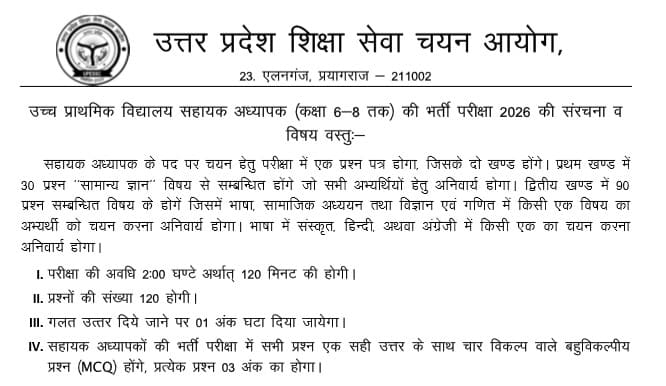
The UP Junior Teacher (Class 6-8) exam has a genuinely different structure from PRT — it’s still 120 questions, 120 minutes, 3 marks per question, 360 total marks, -1 negative marking, but the paper is split into two sections, and Section 2 requires the candidate to choose one stream out of three.
| Section | Content | Marks |
|---|---|---|
| Section 1 | General Knowledge (सामान्य ज्ञान) — compulsory for every candidate | 30 |
| Section 2 | Choose ONE: (क) Language — Sanskrit/Hindi/English (चुनें कोई एक) / (ख) Social Studies (सामाजिक अध्ययन) / (ग) Science & Mathematics (विज्ञान एवं गणित) | 90 |
| Total | 120 |
- Duration: 2:00 hours (120 minutes)
- Total questions: 120 (30 compulsory + 90 from the chosen stream)
- Marks per question: 3
- Total marks: 360
- Negative marking: -1 mark per wrong answer
- Question format: Multiple-choice, 4 options, 1 correct answer
Candidates applying as a Language teacher choose one of Sanskrit, Hindi, or English for Section 2. Candidates applying as a Social Studies teacher attempt the Social Studies stream, and candidates applying as a Science & Maths teacher attempt the Science & Mathematics stream — the stream is tied to the specific teaching post applied for, not a free choice at exam time.
UP Junior Teacher Syllabus 2026: Section 1 — General Knowledge
This 30-question section is compulsory for every UP Junior Teacher candidate, regardless of which Section 2 stream they choose.
| # | Topic — Hindi | Topic — English |
|---|---|---|
| 1 | राष्ट्रीय और अंतर्राष्ट्रीय महत्व की समसामयिक घटनाएँ | Current affairs of national and international importance |
| 2 | भारत का इतिहास एवं भारतीय राष्ट्रीय आन्दोलन | History of India and the Indian national movement |
| 3 | भारत का भूगोल | Geography of India |
| 4 | भारतीय राजनीति एवं शासन–संविधान, राजनीतिक व्यवस्था, पंचायती राज, लोकनीति आधिकारिक प्रकरण आदि | Indian polity and governance — Constitution, political system, Panchayati Raj, public-policy matters, etc. |
| 5 | आर्थिक और सामाजिक विकास — सतत विकास, गरीबी अन्तर्विष्ट जनसांख्यिकीय, सामाजिक क्षेत्र के इनिशिएटिव आदि | Economic and social development — sustainable development, poverty, inclusive demographics, social-sector initiatives, etc. |
| 6 | पर्यावरण एवं पारिस्थितिकी सम्बन्धी सामान्य विषय, जैव विविधता एवं जलवायु परिवर्तन | General topics on environment and ecology, biodiversity and climate change |
| 7 | सामान्य विज्ञान | General Science |
| 8 | Analogies, assertion and reason, binary logic, classification, clocks and calendars, coded inequalities, coding-decoding | (Reasoning topics — given in English in the official notification) |
UP Junior Teacher Syllabus 2026: Language Stream (Hindi/English/Sanskrit)
Candidates applying as a Language teacher choose exactly one of these three subjects for the 90-question Section 2.
| # | Hindi (हिन्दी) | English | Sanskrit (संस्कृत) |
|---|---|---|---|
| 1 | हिन्दी साहित्य एवं भाषा का इतिहास (History of Hindi literature and language) | History of English Literature and Language | संस्कृत भाषा एवं साहित्य के इतिहास की जानकारी (History of Sanskrit language and literature) |
| 2 | व्याकरण (Grammar) | Grammar | व्याकरण (Grammar) |
| 3 | अपठित गद्यांश तथा पद्यांश (Unseen prose and poetry passages) | Unseen Passage | अपठित गद्यांश/पद्यांश (Unseen prose/poetry passages) |
| 4 | प्रमुख लेखकों/कवियों का सामान्य परिचय एवं उनकी रचनाएँ (General introduction to major writers/poets and their works) | Writers/Poets — general introduction and their work | प्रमुख लेखकों/कवियों का सामान्य परिचय एवं उनकी कृतियाँ (General introduction to major writers/poets and their works) |
UP Junior Teacher Syllabus 2026: Social Studies Stream
For candidates applying as a Social Studies teacher, Section 2 (90 questions) covers these 35 topics.
| # | Topic — Hindi | Topic — English |
|---|---|---|
| 1 | इतिहास जानने के स्त्रोत | Sources of knowing history |
| 2 | पाषाणकालीन संस्कृति, ताम्र पाषाणिक संस्कृति, वैदिक संस्कृति | Stone Age culture, Chalcolithic culture, Vedic culture |
| 3 | छठी शताब्दी ई० पू० का भारत | India in the 6th century BCE |
| 4 | भारत के प्रारम्भिक राज्य | Early kingdoms of India |
| 5 | भारत में मौर्य साम्राज्य की स्थापना | Establishment of the Mauryan Empire in India |
| 6 | मौर्योत्तरकालीन भारत, गुप्तकाल, राजपूत कालीन भारत, पुष्यभूति वंश, दक्षिण भारत के राज्य | Post-Mauryan India, the Gupta period, Rajput-era India, the Pushyabhuti dynasty, kingdoms of South India |
| 7 | छठी शताब्दी का धार्मिक तथा सामाजिक विकास | Religious and social developments of the 6th century |
| 8 | इस्लाम का भारत में आगमन, दिल्ली सल्तनत की स्थापना, विस्तार, विघटन | Advent of Islam in India, establishment, expansion and decline of the Delhi Sultanate |
| 9 | मुगल साम्राज्य, संस्कृति, पतन | The Mughal Empire, its culture, and decline |
| 10 | यूरोपीय शक्तियों का भारत में आगमन एवं अंग्रेजी राज्य की स्थापना | Arrival of European powers in India and establishment of British rule |
| 11 | भारत में कम्पनी राज्य का विस्तार | Expansion of Company rule in India |
| 12 | भारत में नवजागरण, भारत में राष्ट्रवाद का उदय | The Renaissance in India, the rise of nationalism in India |
| 13 | स्वाधीनता आन्दोलन, स्वतंत्रता प्राप्ति, भारत विभाजन | The freedom movement, independence, and the partition of India |
| 14 | स्वतंत्र भारत की चुनौतियाँ | Challenges of independent India |
| 15 | हम और हमारा समाज | Us and our society |
| 16 | ग्रामीण एवं नगरीय समाज व रहन-सहन, ग्रामीण एवं नगरीय स्वशासन | Rural and urban society and lifestyle, rural and urban self-governance |
| 17 | जिला प्रशासन | District administration |
| 18 | हमारा संविधान, केन्द्रीय व राज्य शासन व्यवस्था | Our Constitution, central and state government systems |
| 19 | भारत में लोकतंत्र | Democracy in India |
| 20 | देश की सुरक्षा एवं विदेश नीति, वैश्विक समुदाय एवं भारत | National security and foreign policy, the global community and India |
| 21 | नागरिक सुरक्षा, यातायात सुरक्षा | Civil defence, traffic safety |
| 22 | दिव्यांगता | Disability |
| 23 | सौरमण्डल मे पृथ्वी, ग्लोब पृथ्वी पर स्थानों का निर्धारण, पृथ्वी की गतियाँ | Earth in the solar system, locating places on a globe, movements of the earth |
| 24 | मानचित्रण, पृथ्वी के चार परिमण्डल, स्थल मण्डल पृथ्वी की संरचना, पृथ्वी के प्रमुख स्थलरूप | Map-making, the four spheres of the earth, the lithosphere, the earth’s structure, major landforms |
| 25 | विश्व में भारत, भारत का भौतिक स्वरूप, मृदा, उर्वरक का प्रयोग एवं महत्व, वनस्पति एवं वन्य जीव, भारत की जलवायु, भारत के आर्थिक संसाधन, यातायात, व्यापार एवं संचार | India in the world, India’s physical features, soil, use and importance of fertilisers, flora and fauna, India’s climate, India’s economic resources, transport, trade and communication |
| 26 | उत्तर प्रदेश–भारत में स्थान, राजनीतिक विभाग, जलवायु, मृदा, वनस्पति एवं वन्यजीव, कृषि, खनिज | Uttar Pradesh — its place in India, political divisions, climate, soil, flora and fauna, agriculture, minerals |
| 27 | उद्योग-धन्धे, जनसंख्या एवं नगरीकरण | Industries, population and urbanisation |
| 28 | वायुमण्डल, जलमण्डल | Atmosphere, hydrosphere |
| 29 | संसार के प्रमुख प्राकृतिक प्रदेश एवं जनजीवन | Major natural regions of the world and human life |
| 30 | खनिज संसाधन, उद्योग-धन्धे | Mineral resources, industries |
| 31 | भारतीय अर्थव्यवस्था एवं उसकी चुनौतियाँ | The Indian economy and its challenges |
| 32 | पर्यावरण, प्राकृतिक संसाधन एवं उनकी उपयोगिता | Environment, natural resources and their utility |
| 33 | प्राकृतिक संतुलन, संसाधनों का उपयोग | Natural balance, use of resources |
| 34 | जनसंख्या वृद्धि का पर्यावरण पर प्रभाव, पर्यावरण-प्रदूषण | Impact of population growth on the environment, environmental pollution |
| 35 | अपशिष्ट प्रबन्धन, आपदाएँ, पर्यावरणविद, पर्यावरण के क्षेत्र में पुरस्कार, पर्यावरण दिवस, पर्यावरण कैलेण्डर | Waste management, disasters, environmentalists, awards in the field of environment, Environment Day, environment calendar |
UP Junior Teacher Syllabus 2026: Science & Maths Stream
For candidates applying as a Science & Maths teacher, Section 2 (90 questions) is drawn from Mathematics (13 topics) and Science (22 topics) combined.
Mathematics
| # | Topic — Hindi | Topic — English |
|---|---|---|
| 1 | प्राकृतिक संख्याएँ, पूर्ण संख्याएँ, परिमेय संख्याएँ | Natural numbers, whole numbers, rational numbers |
| 2 | पूर्णांक, कोष्ठक, लघुत्तम समापवर्त्य एवं महत्तम समापवर्तक | Integers, brackets, LCM and HCF |
| 3 | वर्गमूल, घनमूल, सर्वसमिकाएँ | Square roots, cube roots, identities |
| 4 | बीजगणित, अवधारणा-चर संख्याएँ, अचर संख्याएँ, चर संख्याओं की घात | Algebra — concept of variables, constants, powers of variables |
| 5 | बीजीय व्यंजकों का जोड़, घटाना, गुणा एवं भाग, बीजीय व्यंजकों के पद एवं पदों के गुणांक, सजातीय एवं विजातीय पद, व्यंजकों की डिग्री, एक, दो एवं त्रिपदीय व्यंजकों की अवधारणाए | Addition, subtraction, multiplication and division of algebraic expressions; terms and coefficients; like and unlike terms; degree of expressions; monomial, binomial and trinomial expressions |
| 6 | युगपत समीकरण, वर्ग समीकरण, रेखीय समीकरण | Simultaneous equations, quadratic equations, linear equations |
| 7 | समान्तर रेखाएँ, चतुर्भुज की रचनाएँ, त्रिभुज | Parallel lines, construction of quadrilaterals, triangles |
| 8 | वृत्त और चक्रीय चतुर्भुज, वृत्त की स्पर्श रेखाएँ | Circles and cyclic quadrilaterals, tangents to a circle |
| 9 | अनुपात, समानुपात, प्रतिशतता, लाभ-हानि, साधारण ब्याज, चक्रवृद्धि ब्याज | Ratio, proportion, percentage, profit-loss, simple interest, compound interest |
| 10 | सांख्यिकी–आंकड़ों का वर्गीकरण, पिक्टोग्राफ, माध्य, माध्यिका एवं बहुलक, बारम्बारता | Statistics — classification of data, pictographs, mean, median and mode, frequency |
| 11 | पाई एवं दण्ड चार्ट, अवर्गीकृत आँकड़ों का चित्र | Pie charts and bar charts, diagrams of ungrouped data |
| 12 | सम्भावना (प्रायिकता), ग्राफ, दण्ड आरेख तथा मिश्रित दण्ड आरेख | Probability, graphs, bar diagrams and composite bar diagrams |
| 13 | कार्तीय तल, क्षेत्रमिति (मेन्सुरेशन), घातांक, त्रिकोणमिति | Cartesian plane, mensuration, exponents, trigonometry |
Science
| # | Topic — Hindi | Topic — English |
|---|---|---|
| 1 | दैनिक जीवन में विज्ञान, महत्वपूर्ण खोज, महत्व, मानव, विज्ञान एवं प्रौद्योगिकी | Science in daily life, important discoveries, their significance, humans, science and technology |
| 2 | रेशे एवं वस्त्र, रेशों से वस्त्रों तक (प्रक्रिया) | Fibres and fabrics, the process from fibre to fabric |
| 3 | सजीव, निर्जीव पदार्थ – जीव जगत, सजीवों का वर्गीकरण, जन्तु एवं वनस्पति के आधार पर पौधों का वर्गीकरण एवं जन्तुओं का वर्गीकरण, जीवों में अनुकूलन, जन्तुओं एवं पौधों में परिवर्तन | Living and non-living matter — the living world, classification of living organisms, classification of plants and animals, adaptation in organisms, changes in animals and plants |
| 4 | जन्तु की संरचना व कार्य | Structure and function of animals |
| 5 | सूक्ष्म जीव एवं उनका वर्गीकरण तथा उनसे होने वाली बीमारियाँ और उनकी रोकथाम | Microorganisms and their classification, diseases caused by them and their prevention |
| 6 | कोशिका से अंगतन्त्र तक | From cell to organ system |
| 7 | किशोरावस्था, विकलांगता | Adolescence, disability |
| 8 | भोजन, स्वास्थ्य, स्वच्छता एवं रोग, फसल उत्पादन, नाइट्रोजन चक्र | Food, health, hygiene and disease, crop production, the nitrogen cycle |
| 9 | जन्तुओं में पोषण, पौधों में पोषण, जनन, लाभदायक पौधे | Nutrition in animals, nutrition in plants, reproduction, useful plants |
| 10 | जीवों में श्वसन, उत्सर्जन, लाभदायक जन्तु | Respiration and excretion in organisms, useful animals |
| 11 | पोषण, विटामिन्स, हार्मोन्स एवं खनिज लवण | Nutrition, vitamins, hormones and mineral salts |
| 12 | मापन, विद्युत धारा, चुम्बकत्व, गति, बल एवं यंत्र | Measurement, electric current, magnetism, motion, force and machines |
| 13 | ऊर्जा, ध्वनि, स्थिर विद्युत, प्रकाश एवं प्रकाश यंत्र | Energy, sound, static electricity, light and optical instruments |
| 14 | वायु– गुण, संघटन, आवश्यकता, उपयोगिता, ओजोन परत, हरित गृह प्रभाव | Air — properties, composition, need, utility, the ozone layer, the greenhouse effect |
| 15 | जल– आवश्यकता, उपयोगिता, स्त्रोत, गुण, प्रदूषण, जल-संरक्षण | Water — need, utility, sources, properties, pollution, water conservation |
| 16 | पदार्थ, पदार्थों के समूह, पदार्थों का पृथक्करण, पदार्थ की संरचना एवं प्रकृति | Matter, groups of substances, separation of substances, structure and nature of matter |
| 17 | अम्ल, क्षार, लवण | Acids, bases, salts |
| 18 | ऊष्मा एवं ताप | Heat and temperature |
| 19 | मानव निर्मित वस्तुएँ, प्लास्टिक, काँच, साबुन, मृतिका | Man-made materials — plastic, glass, soap, clay |
| 20 | खनिज एवं धातु, कार्बन एवं उसके यौगिक | Minerals and metals, carbon and its compounds |
| 21 | ऊर्जा के वैकल्पिक स्त्रोत | Alternative sources of energy |
| 22 | आवर्त सारिणी, रक्त की संरचना, वर्ग एवं रक्त के आदान-प्रदान में सावधानियाँ | The periodic table, composition of blood, blood groups and precautions in blood transfusion |
UP PRT vs UP Junior Teacher: Key Differences
| Point | UP Primary Teacher (PRT) | UP Junior Teacher |
|---|---|---|
| Classes taught | 1 to 5 | 6 to 8 |
| Paper structure | Single section, same syllabus for everyone | 2 sections — compulsory GK + 1 chosen stream |
| Subject choice | None | Yes (Language / Social Studies / Science & Maths) |
| GK/Current Affairs weightage | 25 questions (within the single section) | 30 questions (Section 1, compulsory) |
| Subject depth | Broader spread across 10 subjects, including Teaching Skills and Child Psychology | Deeper, single-subject focus (90 questions) in whichever stream is chosen |
| Total questions/marks | 120 / 360 | 120 / 360 |
| Negative marking | -1 per wrong answer | -1 per wrong answer |
Question Paper Language
Both the UP Primary Teacher (PRT) and UP Junior Teacher question papers will be set in English and Hindi, as confirmed in the official UPESSC syllabus notification for both posts. Candidates can attempt the exam by referring to either language version printed in the same paper.
Preparation Tips for UP PRT & Primary Teacher Exam 2026
- Start with the highest-weightage subjects first. For PRT, that’s Hindi-Sanskrit-English (30 questions) and General Knowledge/Current Affairs (25 questions) — together nearly 46% of the paper. For Junior Teacher, the compulsory GK section (30 questions) matters for every candidate regardless of stream, so it deserves early, consistent revision.
- NCERT textbooks up to Class 8 are the standard base for the Science, Mathematics, and Social Studies portions in both exams, since the syllabus topics map closely to that curriculum.
- Negative marking changes strategy — since 1 mark is deducted for every wrong answer, avoid guessing on questions with no partial elimination; a wrong guess costs more than a skipped question.
- Junior Teacher candidates should lock their stream early. Because Section 2 is tied to the specific post applied for (Language, Social Studies, or Science & Maths), split study time so the 90-question stream gets the bulk of preparation hours, not the 30-question GK section.
- Practice under the 120-minute limit — with 120 questions in 120 minutes, pacing (roughly 1 minute per question) matters as much as accuracy.
REQUIRES OFFICIAL CHECK: this section is general exam-preparation guidance, not part of the official UPESSC syllabus notification.
Important Official PDF Download Links
| Resource | Link |
|---|---|
| Official UPESSC Website | https://upsssc.gov.in/ |
| UP Primary Teacher (PRT) Official Syllabus Notice | Download PDF |
| UP Junior Teacher Official Syllabus Notice | Download PDF |
| For Any Educational Updates Join Telegram Channel | NotifyHere |
| For Any Educational Updates On Whatsapp | Join Whatsapp Channel |
| For Study Material Subscribe YouTube Channel | Subscribe NotifyHere |
FAQ
Is there negative marking in the UP Primary Teacher (PRT) 2026 exam ?
Yes. As per the official UPESSC syllabus notification, 1 mark is deducted for every wrong answer in the UP Primary Teacher (Class 1-5) exam 2026.
Is there negative marking in the UP Junior Teacher (Class 6-8) 2026 exam ?
Yes, the same rule applies — 1 mark is deducted for every wrong answer in the UP Junior Teacher exam as well.
How many questions, how much time, and how many marks per question are there in the PRT exam ?
The UP Primary Teacher exam has 120 MCQs to be attempted in 120 minutes (2 hours), with 3 marks awarded per question, for a total of 360 marks.
How many questions, how much time, and how many marks per question are there in the Junior Teacher exam ?
The UP Junior Teacher exam also has 120 MCQs in 120 minutes (2 hours) at 3 marks per question (360 total marks), split into a 30-question compulsory GK section and a 90-question chosen-stream section.
What optional subject choices are there in the UP Junior Teacher exam ?
Candidates must choose one of three streams for Section 2: Language (Sanskrit, Hindi, or English — pick one), Social Studies, or Science & Mathematics, in addition to the compulsory 30-question General Knowledge section.
What is the total number of subjects/sections in the UP Primary Teacher syllabus ?
The UP Primary Teacher syllabus covers 10 subjects in a single section: General Knowledge/Current Affairs, Reasoning, Hindi-Sanskrit-English, Science, Mathematics, Environment & Social Studies, Teaching Skills, Child Psychology, Information Technology, and Life Skills/Management & Attitude.
What language will the UP Primary Teacher and Junior Teacher question papers be in ?
Both question papers will be set in English and Hindi, as confirmed in the official UPESSC syllabus notification.
What is the main difference between the UP Primary Teacher (PRT) and UP Junior Teacher exam pattern ?
PRT has a single section covering all 10 subjects for every candidate, while Junior Teacher has two sections — a compulsory 30-question GK section plus a 90-question section from one chosen stream (Language, Social Studies, or Science & Maths) depending on the post applied for.
Where can I download the UP PRT syllabus 2026 PDF ?
Directly from the official UPESSC website (upessc.gov.in), under the Syllabus/Notification section for the Assistant Teacher recruitment — this article summarizes that same official PDF in table form.
What is the UPESSC PRT syllabus for 2026 ?
It covers 10 subjects — General Knowledge/Current Affairs, Reasoning, Hindi-Sanskrit-English, Science, Mathematics, Environment & Social Studies, Teaching Skills, Child Psychology, Information Technology, and Life Skills/Management & Attitude — for 120 questions and 360 marks total.
Is there a separate UP Primary Teacher vacancy 2026 syllabus for Super TET ?
The syllabus in this guide is UPESSC’s official syllabus for the current Assistant Teacher (PRT/Junior Teacher) recruitment cycle — always match the syllabus to your specific notification’s advertisement number, since UP has run differently-named teacher exams in the past.
Disclaimer
This syllabus and exam pattern are based on the official notification released by the UP Shiksha Sewa Chayan Ayog (UPESSC). Candidates should cross-check for any subsequent corrigendum or update directly on the official UPESSC website before finalizing their preparation, as syllabus documents are occasionally revised.
